Walla, Walla, WA | 509-529-7537
509-529-7537
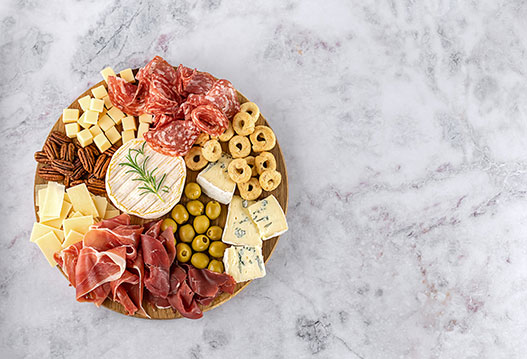
How to Build a Charcuterie Board Using What We Carry
A charcuterie board has become one of those things that looks more complicated than it is. You see elaborate spreads on social media — cascading fruits, sculptural cheese arrangements, color-coordinated everything — and it’s easy to assume there’s a technique involved that takes years to develop.
There isn’t. A great board is really just a collection of things that taste good together, arranged with a little intention. The skill, if you can call it that, is knowing what to put on it. And that starts with understanding what each element is doing.
Here’s how to think about building one, using the kinds of ingredients we carry at D’Olivo.
Start with the Anchors
Every good board has two or three anchors — the things people will return to throughout the evening. Cheese is usually one of them. Something aged and firm, something soft and creamy, and something in between gives you a range that works for different palates. You don’t need six varieties. Three is plenty. We’ve got a great selection of cheeses from Walla Walla Cheese Company to get you started.
Charcuterie in the traditional sense — cured meats — is another anchor. Prosciutto, salami, soppressata, whatever you enjoy. Fold or drape them loosely rather than laying them flat. It sounds fussy but it actually makes them easier to pick up and looks considerably better.
Once your anchors are placed, everything else fills in around them.
Where Balsamic Comes In
This is where a board goes from good to genuinely memorable. A small dish of aged balsamic alongside a wedge of Parmigiano-Reggiano is one of the great simple pleasures in Italian food. The sweetness and acidity of the vinegar does something to aged cheese that’s hard to explain until you try it — it brightens it, cuts through the richness, and makes you want another bite immediately.
A balsamic reduction — made by gently simmering your balsamic until it thickens into a syrup — works beautifully as a drizzle over the whole board or served in a small ramekin for dipping. It also pairs well with fresh fruit. Strawberries, figs, sliced pears — any of these alongside a good dark balsamic makes a combination worth building a board around.
Fig balsamic specifically has an affinity for cheese and charcuterie that’s hard to beat. If you haven’t tried it, a board is one of the best places to start.
Olive Oil as a Dipping Element
A small dish of good extra virgin olive oil with a pinch of flaky salt alongside sliced bread or a baguette is one of the easiest additions to a board and one of the most popular. People gravitate toward it. It gives them something to do while grazing and introduces your olive oil in the most direct way possible — on its own, where the flavor has nowhere to hide.
A flavored oil works well here too. Garlic olive oil with good bread is hard to argue with. A herb-forward oil like Tuscan herb or basil brings something a little more interesting. If you want to offer two options, a robust extra virgin alongside a flavored oil gives people a comparison that’s actually fun to taste through.
Delizia Olives
Olives belong on a charcuterie board. This is not really up for debate. They add brininess, visual contrast, and something savory that rounds out the sweetness from fruit and balsamic. Delizia olives — marinated, flavorful, and far more interesting than the canned variety — are the kind of thing guests comment on. A small bowl tucked into a corner of the board gives people something to pick at between bites of cheese and meat.
Pickled Vegetables
Pickled vegetables serve the same function as olives — acidity and brightness to cut through the richness of cheese and charcuterie — but with a different flavor profile. A small cluster of pickled vegetables adds color and gives the board more range. They’re also the element that tends to surprise people most. Most guests don’t expect them and end up going back for more.
Honey
A small jar or ramekin of good honey is one of the simplest ways to elevate a board. Drizzled over a soft cheese, paired with something salty like prosciutto, or used as a dipping element with bread — honey does a lot of work quietly. The contrast between sweet and salty is part of what makes a board so satisfying to graze on, and honey is one of the most elegant ways to introduce it.
Filling It In
Once your anchors and specialty items are placed, fill the gaps with crackers, sliced bread, fresh fruit, and a few nuts if you like them. The goal is variety in texture and flavor — something crunchy, something soft, something sweet, something salty, something bright. When all of those are present, the board takes care of itself.
Don’t overthink the arrangement. Fill in empty spaces, use small bowls to contain anything liquid or loose, and let things overlap a little. A board that looks abundant and slightly imperfect is more inviting than one that looks like it took two hours to assemble. The best ones usually took twenty minutes.
A Note on Quantity
For a board that’s serving as an appetizer before a meal, plan for about two to three ounces of cheese and two ounces of charcuterie per person. If it’s the main event — a grazing dinner rather than a starter — double that. It’s always better to have slightly more than you need. A board that runs out too quickly is the one thing guests actually notice.
The Bigger Picture
A charcuterie board is one of those things that rewards good ingredients more than almost any other format. Everything is tasted on its own or in simple combinations, which means quality shows immediately and so does the lack of it. A really good olive oil, an aged balsamic worth finishing with, olives that are actually flavorful — these things make a board worth remembering.
The assembly is simple. The ingredients do the work.
INFORMATION
Subscribe to D'Olivo via Email
Stay up to date! Sign up to receive D'Olivo emails
© D'Olivo
Accepted Forms of Payment